Sailing analysis · Offshore
Offshore routing and race preparation
I can help compare routes before an offshore race and prepare a crew brief. We examine the forecast and boat performance assumptions behind each route, including when changing conditions would warrant a new plan.
Choosing what to compare
For a passage with a flexible departure, we can compare when to leave. A fixed race start limits the choices to where to sail afterward. We begin by establishing the course and time constraints.
We review the source of the boat model, whether it is a certificate polar, measured performance or the crew’s estimate of sustainable speed. Sail inventory and handling limits may rule out an otherwise fast angle or maneuver.
Changing one assumption while holding the others fixed helps isolate its effect. We also examine interacting uncertainties: a slower boat may meet a weather feature later, changing the preferred route as well as the arrival time.
What if the boat is slower than planned?
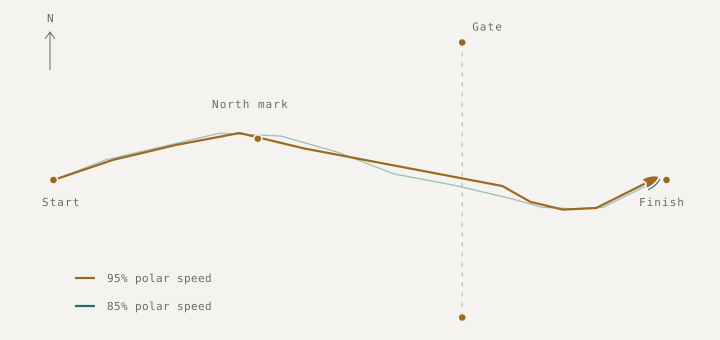
Compare two routes calculated with the same weather and course, at 95% and 85% of polar speed. The percentages specify a fraction of polar speed. They do not express confidence in the forecast or arrival time.
95% performance
114 min · 13.53 nm
Arrival 15:09 UTC
85% performance
126 min · 13.56 nm
Arrival 15:21 UTC
At 85% of polar speed, the boat arrives twelve minutes later. The routes cover almost the same distance, so the difference comes mainly from the assumed speed. The 95% run finishes at 15:09 UTC; the 85% run finishes at 15:21 UTC after the same 13:15 UTC departure.
These two runs estimate sensitivity to boat speed without assigning probabilities to the arrival times. The twelve minutes cannot be scaled directly to a longer race, where the boat may encounter different wind angles, currents or weather transitions.
For your passage, we would check the performance assumption against the expected crew and sails, and confirm that the polar covers the forecast conditions. We would then examine whether the difference in arrival time affects a passage decision.
Model inputs and limits
Both runs use the same wind (11.8 kt), significant wave height (0.8 m), current, depth checks and course requirements. Only the fraction of polar speed changes. Departure: 13:15 UTC. Forecast cutoff: 12:00 UTC, 13 September 2026 (synthetic forecast).
The native routing solver calculated both routes from synthetic weather and boat inputs. They are illustrative and unsuitable for navigation. In both runs, wind exceeds the stored polar range, so the solver clamps the top curve. The comparison does not establish boat performance at that wind strength.
Changing the performance fraction leaves the missing polar coverage unresolved. Both arrival estimates remain subject to that limit.
Updating the route as forecasts change
A route calculated with the weather observed afterward can help estimate what was physically possible. It cannot establish what a navigator should have chosen with the forecast available at the time. A decision review needs to retain the forecast issue time and use only information available before that choice.
The Mackinac study compares following the newest forecast with choosing a route across several recent HRRR runs. Under a 3% limit on added forecast passage time, the latter policy finished about twenty seconds slower per case on average across 16 complete cases. The reported 95% interval included both gains and losses. That study found no average advantage for the more cautious policy.
An alternative route may preserve a later choice if the forecasts disagree, at the cost of extra distance now. We also account for shared errors when interpreting agreement between successive forecasts.
When a new forecast arrives, the boat has already sailed part of the passage. A route that was available at the start may no longer be reachable without a large detour. We can compare the remaining choices from the boat’s position and identify when a decision becomes difficult to reverse.
What belongs in the crew brief
The brief can include the route alternatives, passage and arrival estimates, expected conditions and the assumptions that distinguish the runs. It should identify the forecast cycle, the boat model and any missing coverage, so a later update can be compared on the same basis.
The crew needs to know which observations would warrant reviewing the route. Changes in wind direction, sustained boat speed or the timing of a transition may affect the remaining choices more than a small revision to the arrival estimate.
| Developing condition | What to review |
|---|---|
| Speed remains below the assumption | Check the sailing mode and conditions, then compare the arrival and route consequences of lower sustained performance. |
| A forecast transition moves earlier or later | Recalculate where the boat is likely to meet it, and whether the alternative can still be reached. |
| The expected current differs from observations | Review crossing timing and ground progress. Separate boat speed through water from the current’s contribution. |
| Crew or sail constraints change | Remove options that depend on unavailable handling or sails, and compare the remaining routes. |
We can agree thresholds for reviewing the plan based on the boat, remaining distance and cost of changing course. The brief records the reasons for those thresholds and the observations needed to use them.
The Hawaii research separates departure timing, route comparisons, forecast decisions and effects on corrected time. The Bermuda research examines current assistance and route geometry across editions.
Prepare for your race
Send the boat, course, event date or departure window, and the decisions you want to compare. Include the polar or certificate available, the expected sail inventory, and any handling constraints that should affect the plan. We’ll agree the scope of the brief and the source material needed.
We should also agree when the brief is needed and whether later forecast updates are part of the work. Each saved comparison records its inputs and preparation time.